

Trenchless Sewer Repair
Pipe lining and pipe bursting that renew the line through small access points, leaving the yard where it is.
Last updated
Trenchless sewer repair renews a line from the inside, or pulls a new one along the path of the old one, working through small access points instead of a trench down the length of the run. The mature lawn, the driveway, the patio, the big cottonwood and the sprinkler system all stay where they are.
We do both methods that matter for a house: cured-in-place pipe lining, which forms a new jointless pipe inside the existing one, and pipe bursting, which tows a new pipe in while breaking the old one outward. They suit different lines, and the camera inspection is what tells us which one yours is.
Either way the finished pipe improves on what the line started with — continuous where the old pipe had joints, smooth-walled, and designed for a fifty-year service life.
Trenchless Sewer Repair calls in Durango run out of our 178 Bodo Dr, Suite C office. We cover Durango, Bayfield, Ignacio, Hesperus, Mancos, Vallecito and the rest of La Plata County, and the Durango crew is on call 24 hours a day.
What cured-in-place pipe lining actually is
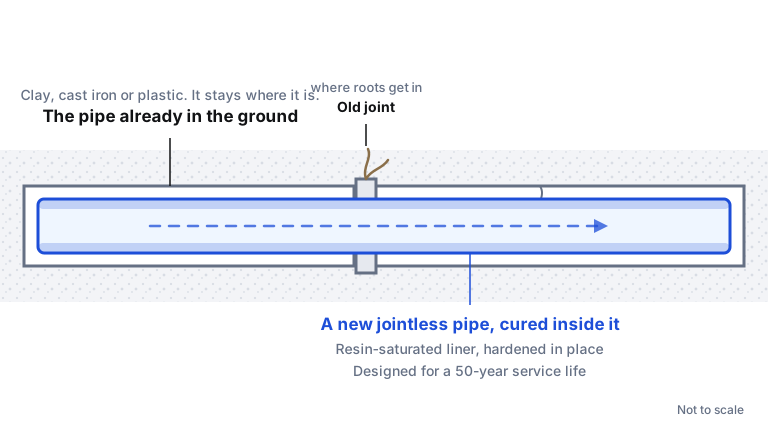
A flexible liner — layered felt or fiberglass — is saturated with a two-part resin, a step the trade calls the wet-out. It is then inverted or pulled into the existing pipe and pressed tight against the inside wall along the whole run.
The resin is cured in place, using hot water, steam or ultraviolet light depending on the liner and the line. The result is a hard, continuous pipe formed inside the old one, bonded to it and following its path, bends included.
The method is standardized: the North American industry works to ASTM F1216, the practice covering rehabilitation by inversion and curing of a resin-impregnated tube, and the accepted design life of a cured liner is fifty years.
The jointless part is what makes it worth doing. Almost everything that ends an old sewer line gets in at a joint — roots, groundwater, soil. A cured liner has none along its length, so the route the old pipe failed by is no longer open to the new one.
What pipe bursting is, and when it is the better answer
Pipe bursting suits lines that are past lining. A bursting head is drawn through the existing pipe on a cable, fracturing it outward into the surrounding soil while towing new pipe in behind it, along the same path.
The new pipe is HDPE with fused joints — the lengths are heat-welded into one continuous pipe before it goes in, so there is no glued or gasketed joint anywhere in the run for a root to find.
It also answers something lining cannot: diameter. Because the old pipe is displaced rather than lined, the replacement can come back the same size or larger, and an undersized line can typically be upsized by something in the order of twenty to fifty percent — a four-inch lateral returning as six — without trenching its length.
It needs an entry and an exit pit, so it is not literally digging-free. It is two small holes instead of a trench across the property.
Which one your line gets
Lining suits a host pipe still doing its structural job: cracked, leaking at the joints, taking roots, scaled up inside, but holding its shape and its line.
Bursting suits a pipe that has lost its shape — collapsed or badly deformed sections, a run that has separated, or a line that needs to come back bigger than it went in.
A line with a significant belly in it is its own conversation, because neither method changes the grade a pipe sits at. Where the fall is the actual problem, the right answer is excavation and re-laying that section, and we will say so.
None of this is guesswork from the surface. The camera inspection answers it, you see the same footage we do, and the recommendation arrives with its reason attached.
What the job looks like from your side of it
Access first. Where a property has cleanouts — the capped pipes near the foundation or out toward the property line — the work usually goes through those, and where it does not, a small pit is dug at one or both ends.
Then the pipe is cleaned, and this is the step that decides whether the finished job lasts. Mechanical descaling with cutters and chains takes off hard scale and roots, and hydro jetting at several thousand PSI scours what is left. On old cast iron, both: a liner can only bond to a wall that has been taken back to the pipe.
The line is measured, the liner cut and wet out to that length, installed, and cured — a short residential run is often a couple of hours, a longer or more complex one most of a working day. Water use inside the house pauses while it cures, and we tell you exactly when and for how long.
Branch connections are then reopened from the inside with a cutter, a final camera run goes down the finished pipe, and you get that footage too. Most houses are one to two days on site, rather than the week an open-cut replacement of the same run would take.
What you end up with
A continuous pipe with no joints along its length, a smooth bore that carries flow well, and a wall that resists the roots and groundwater that ended the original line.
A liner does take up a little of the inside diameter, which sounds like a drawback and rarely behaves like one: the new surface is far smoother than decades-old clay or scaled cast iron, so a lined line commonly drains better than the pipe it was formed inside.
And the yard is still a yard. For a lot of properties that is the whole decision — the pipe was always going to be fixed, and the question was what the garden, the drive and the trees looked like afterwards.
What this covers
- Cured-in-place pipe lining
- Pipe bursting
- Sectional spot liners
- Access through existing cleanouts
- Jointless finished pipe
- 50-year design life
Towns we cover from Durango
Questions
Trenchless Sewer Repair in Durango
Is a lined pipe as strong as a new one?
A cured-in-place liner is a structural pipe in its own right — it is designed to carry the load on its own, which is why the accepted design life is fifty years and why the method is used on municipal mains as well as house laterals. It is standardized under ASTM F1216, the practice covering rehabilitation by inversion and curing of a resin-impregnated tube.
How long does trenchless sewer repair take?
Most residential jobs are one to two days on site. The cure itself is a matter of hours — a short run with a fast resin can be a couple, a longer or larger line most of a day. The camera inspection and the cleaning that come first usually set the schedule, not the lining.
Can I use water in the house while the liner cures?
Water use pauses during the cure, and we give you that window before we start rather than discovering it together. For a typical house it is a few hours in one day, and it is worth planning around the way you would plan around a floor being refinished.
Does lining make my pipe narrower?
It takes up a small amount of the inside diameter, and in practice flow usually improves rather than drops, because the liner surface is much smoother than aged clay, scaled cast iron or root-roughened plastic. Where a line genuinely needs to be bigger than it was, that is what pipe bursting is for — it can typically bring a four-inch lateral back as six.
Does trenchless work really avoid digging?
Lining usually works through existing cleanouts and needs no trench at all. Pipe bursting needs an entry and an exit pit, so it is two small holes rather than a trench along the length of the run. Either way the mature landscaping, the driveway and the concrete in between stay untouched.
Will roots come back through a lined pipe?
Roots get into a sewer at joints and cracks, and a cured liner is continuous along its length with neither. Pipe bursting gives you the same advantage differently: the new HDPE is heat-fused into one pipe before it goes in the ground, so there is no gasketed joint in the run.
How do I find out whether my line can be lined?
A camera inspection, and it is the first thing we do on any sewer job. It shows the material, the condition of every joint, how much of the bore is open, and whether the line is holding its shape and its fall — which is exactly the set of facts that decides between lining, bursting and excavation.
Need trenchless sewer repair in Durango?
Most repairs are finished on the first visit. Emergency crews run 24/7 across the Four Corners.